
My daughter thought she had her math lesson figured out. She’d been doing well all week, so when I sat down to go over the next concept with her, she brushed me off. “I already know this, mom. I don’t need help.”
Ten minutes later, she was frustrated, stuck, and finally willing to listen.
We’ve all been there, haven’t we? The moment when we realize we don’t have it all figured out. When asking for help would have saved us SO much time and frustration. It’s a hard lesson, and one our kids will learn over and over again throughout their lives.
Humility might be the character trait that makes all the others possible. It’s what keeps courage from becoming arrogance and kindness from becoming performance. It’s what makes room for growth, for receiving help, for celebrating others without feeling threatened. And it might be one of the most countercultural things we can teach our kids today.
That’s why we’re spending March focused on it. All year, we’re exploring one Christ-like character trait each month as a WonderWell Learning community, through scripture, classes, and practical ideas for home. January was courage. February was kindness. Now we’re ready to dig into humility, and we’d love for you to join us.
Our culture doesn’t exactly celebrate humility. We reward self-promotion, confidence that borders on arrogance, and always having the right answer. But scripture paints a very different picture of what it means to live well.
Teaching humility to kids isn’t about making them think less of themselves, but about helping them think of themselves less. There’s a big difference. A humble child isn’t one who shrinks back or doubts their worth. They’re secure enough to celebrate a sibling’s success, teachable enough to accept correction, and aware enough to know they don’t have all the answers.
For younger kids, humility might look like saying “I was wrong” without a meltdown, letting someone else go first, or being willing to try again after making a mistake. For older kids, it may look like not always needing to be right in an argument or asking for help on a subject they’re struggling with. It’s recognizing that their gifts and talents aren’t self-made but God-given.
Homeschooling gives us the immense gift of time with our kids, and we get to be their strongest example of humility in real time. That means admitting when a curriculum isn’t working instead of pushing through out of pride. Bringing in support for subjects that don’t come naturally to us. Letting go of the picture-perfect homeschool in our heads and embracing the real, messy, beautiful one in front of us.
Our kids see us make mistakes, apologize, and try again. They watch us learn new things right alongside them. They hear us say, “I don’t know, let’s find out together.” And in doing so, we’re teaching humility over and over again without ever giving a formal lesson on it.
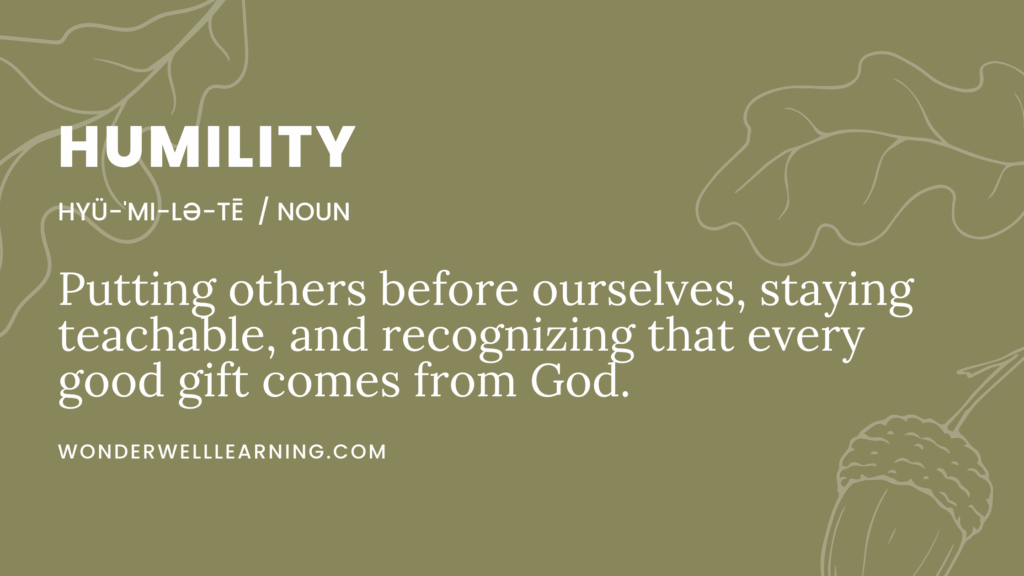
Humility runs deep in scripture. It’s not presented as weakness, but rather as the posture God honors. This month, we’re anchoring our hearts in what the Bible teaches about putting others first and nurturing humble hearts.
Philippians 2:3-4 gives us a clear picture. “Let nothing be done through strife or vainglory; but in lowliness of mind let each esteem other better than themselves. Look not every man on his own things, but every man also on the things of others.”
This is the complete opposite of how the world tells us to operate. Instead of looking out for number one, we’re called to consider others and to lift up the people around us.
James 4:10 offers both an instruction and a promise. “Humble yourselves in the sight of the Lord, and he shall lift you up.”
We don’t have to fight for our place or recognition. When we humble ourselves before God, He is the one who lifts us up in His timing and in His way.
Proverbs 22:4 connects humility to an abundance of blessings. “By humility and the fear of the Lord are riches, and honour, and life.”
The world chases riches, honor, and a full life through hard work and self-promotion. But scripture shows us the path runs through humility and reverence for God. In the eyes of the world, it’s an upside-down kingdom. And it’s the one we’re raising our kids to live in.
A note from Taylor, WonderWell Learning co-founder:
I am convinced that losing gracefully is not a skill we’re born with. It has to be gently shaped by experience. And kids? They’re naturally terrible at it.
One of the simplest ways we’ve found to practice in our home is through board games. When my kids were little, we played a lot of co-op style games where everyone works as a team toward a common goal. The stakes of losing are still there, but it’s a gentler introduction when your “enemy” is the game itself instead of the people sitting next to you.
As they’ve gotten older, we’ve introduced competitive games into the mix. When the team dynamic is removed, it’s trickier to lean on grace when you lose. But it also holds up a mirror to life. There are seasons where we work as a team, but often it’s just you. Learning to win and lose with grace when it all falls on your shoulders matters just as much.
We always leave room for multiple rounds. The first game lets them move through the initial wave of disappointment. Every one after gives them a chance to anticipate their reaction and work toward something more gracious.
But the one thing that has helped my kids the very most? Focusing on others instead of themselves. We can sit in the sadness that things didn’t go our way, or we can put our energy toward celebrating the person who won. My kids learned quickly that game nights are a lot more fun when we choose joy over being bummed out. And those nights have become some of our sweetest family time, the kind where everyone’s laughing and enjoying just being together.
If you’re looking to use games as a character-building tool in addition to a family bonding experience, here are a few tips:
Humility isn’t about pretending the loss doesn’t sting. It’s about choosing to celebrate someone else even when it does.
When our kids have the opportunity to learn in a community setting, humility becomes something they can practice in safe spaces. Here are classes where teachable spirits and servant hearts are woven right into the learning this month:
Every class at WonderWell Learning is tagged with the character values students will grow in (courage, creativity, perseverance, kindness, and more!). As you build their schedule with classes that build academics and skills, you’ll always have easy-access to the way they’re growing in character as well.
Browse all our character-building classes here
Looking for simple ways to make humility a focus this March? Here are ideas for every age:
For younger kids (5-10):
For tweens/teens (11+)
For the whole family:
All month long, we’ll be sharing more about teaching humility to kids on social media—stories from our classes, book recommendations, humility-building activities, scriptures to anchor in, and real moments from our community.
Follow along on Instagram and Facebook, and share your own kindness moments with us. We’d love to celebrate the compassion you’re seeing in your homeschools.
Coming up in April: Joy. Real, deep, unshakeable joy isn’t about circumstances, it’s rooted in something so much bigger.
Here’s to a March of teachable hearts, open hands, and kids who know that the best things in life aren’t earned but received.
Browse character-building classes: classes.wonderwelllearning.com
Each month, we focus on one character trait at WonderWell Learning—exploring how it shows up in our classes, our families, and our homeschools. Follow along as we build courage, kindness, perseverance, creativity, and more throughout the year.